
Weight Watchers scales empower users to monitor their progress, offering a crucial tool for achieving wellness goals. These scales seamlessly integrate with the Weight Watchers app.
By purchasing a Weight Watchers scale, you’re taking a proactive step towards managing your weight effectively, aided by detailed instructions and data tracking.
What are Weight Watchers Scales?
Weight Watchers scales are specialized bathroom scales designed to accurately measure body weight and, in some models, provide additional body analysis data. They are often engineered for seamless synchronization with the Weight Watchers mobile application via Bluetooth connectivity.
These scales aren’t simply about displaying a number; they’re integrated components of the Weight Watchers program, facilitating easy tracking of weight fluctuations. The Conair Weight Watchers WW711F is a prime example, offering precise weight measurements. Detailed instructions are provided to ensure accurate readings.
Benefits of Using a Weight Watchers Scale
Utilizing a Weight Watchers scale offers numerous advantages for individuals committed to weight management. Automatic data syncing with the Weight Watchers app eliminates manual logging, providing a convenient tracking experience.
These scales promote accountability and motivation by visualizing progress. They can be customized for multiple users, making them ideal for families. Following the instructions carefully ensures accurate measurements, contributing to a more effective weight loss journey. Taking control of your weight starts with this first step!

Unboxing and Initial Setup
Weight Watchers scales arrive with all necessary components for immediate use. Carefully review the included instructions before proceeding with battery installation and initial setup.
What’s Included in the Box?
Upon opening your Weight Watchers scale package, ensure all components are present. Typically, you’ll find the scale itself, a quick start guide offering basic instructions, and a detailed user manual – often available as a PDF online.
Battery installation may require batteries not included, so verify this before beginning. Some models include batteries. The box should also contain important safety instructions and warranty information. Carefully inspect all items for any damage incurred during shipping. Retain the packaging for potential returns or warranty claims.
Installing Batteries
Before first use, battery installation is essential. Locate the battery compartment, usually on the scale’s rear panel; Refer to the instruction manual for the correct battery type and polarity (+/-). Gently open the compartment and insert the batteries accordingly.
Ensure a secure fit. Do not mix old and new batteries. If the scale doesn’t power on, double-check battery placement and replace if necessary. Proper battery installation guarantees accurate weight readings and optimal scale functionality.

Understanding Scale Features
Weight Watchers scales offer unit selection (kg, lbs, st), user profile memory for personalized tracking, and Bluetooth connectivity for seamless app integration.
Weight Measurement Units (kg, lbs, st)
Weight Watchers scales provide versatility by allowing you to select your preferred weight measurement unit. You can easily switch between kilograms (kg), pounds (lbs), and stones (st) to suit your preference.
To change the unit, consult your scale’s instruction manual. Typically, this involves pressing a button on the scale’s underside or within the settings menu accessible through the connected app.
Ensure the correct unit is selected before each weigh-in for accurate tracking and consistent monitoring of your weight loss journey.
User Profile Memory
Many Weight Watchers scales feature user profile memory, allowing multiple individuals to track their weight on a single device. This is particularly useful for families or households with several users.
These scales can typically store data for up to four users, as indicated in some instruction manuals. Each user creates a unique profile, ensuring personalized and accurate weight tracking.
Refer to your scale’s manual for specific instructions on adding, editing, and selecting user profiles before each weigh-in to ensure data is correctly assigned.
Bluetooth Connectivity & App Integration
Weight Watchers scales often boast Bluetooth connectivity, enabling seamless synchronization with the Weight Watchers Scales by Conair app. This integration automates weight logging, eliminating manual entry.
Downloading and installing the app is the first step, followed by pairing your scale via Bluetooth. The app provides a user-friendly interface for tracking progress and visualizing data.
Consult your scale’s instruction manual for detailed pairing instructions and troubleshooting tips if you encounter connection issues. This feature enhances the overall weight management experience.
Using Your Weight Watchers Scale
Weight Watchers scales require firm placement and a gentle tap to activate. Stand still with your weight evenly distributed for accurate readings, as per instructions.
Proper Placement for Accurate Readings
Weight Watchers scales function best on a hard, level surface. Avoid carpets or uneven flooring, as these can compromise accuracy. Gently tap the center of the scale with your foot to activate the display before stepping on. Ensure the scale isn’t touching a wall or any other object.
Consistent placement is key; always use the same spot for reliable measurements. A stable surface minimizes fluctuations and provides the most consistent weight data, following the instructions in your manual.
How to Weigh Yourself Correctly
Step onto the scale with your feet evenly distributed, ideally towards the center. Avoid leaning against anything for support, as this can affect the reading. Remove shoes and heavy clothing for consistency. Wait for the display to stabilize before noting the weight.
Don’t move or talk while weighing. Firmly tap the center with the ball of your foot to wake it up, but don’t linger. Follow these instructions for the most accurate results.
Reading the Display
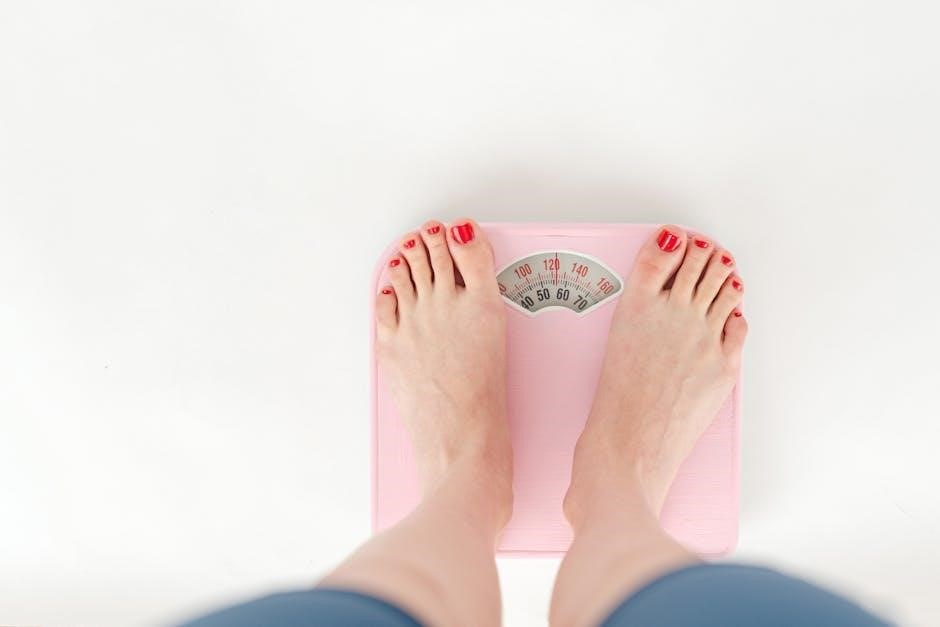
The Weight Watchers scale display will illuminate upon activation. Allow a few seconds for the reading to stabilize – a steady number indicates an accurate measurement. The display shows weight in kilograms (kg), pounds (lbs), or stones (st), depending on your selected unit.
Ensure sufficient lighting to clearly view the numbers. Refer to the manual for specific display symbols or error messages. Consistent reading practices, following instructions, are key.
Setting Up User Profiles
Weight Watchers scales can store data for multiple users, up to four, allowing personalized tracking. Follow the instructions to add and customize each profile.
Adding a New User
To add a new user profile, begin by ensuring the scale is awake – a firm tap to the center should activate it. Within the Weight Watchers app, navigate to the ‘Users’ section and select ‘Add User’. You’ll be prompted to enter personal details like age, height, and weight.
Carefully input this information, as it impacts calculations. The scale will then assign a user number. Repeat this process for each individual who will be tracking their weight on the device, following all instructions provided within the app for a seamless setup.
Editing User Information
Within the Weight Watchers app, access the ‘Users’ section to modify existing profiles. Select the user you wish to edit, and you’ll find options to update details like height, weight, or birthdate. Ensure accuracy when making changes, as these directly influence weight tracking.
Save your alterations after reviewing them. The scale will reflect these updates upon synchronization. Refer to the manual or app instructions if you encounter difficulties, guaranteeing personalized and precise data for each user’s wellness journey.

Connecting to the Weight Watchers App
Download the Weight Watchers Scales by Conair app to easily track measurements. Pair your scale via Bluetooth for seamless data synchronization and progress monitoring.
Downloading and Installing the App
To begin, locate the Weight Watchers Scales by Conair app on your device’s app store (Apple App Store or Google Play Store). Search for “Weight Watchers Scales” and select the app developed by Conair.
Tap the “Install” button and allow the app to download and install on your smartphone or tablet. Once installed, open the app and follow the on-screen prompts to create an account or log in with your existing Weight Watchers account. Ensure you grant the app necessary permissions, such as Bluetooth access, for optimal functionality.
Pairing the Scale with Your Device
Ensure Bluetooth is enabled on your smartphone or tablet. Open the Weight Watchers Scales app and navigate to the “Devices” or “Connect Scale” section. The app will begin searching for available scales;
Place your foot briefly on the scale to activate it. Select your Weight Watchers scale from the list of discovered devices within the app. Follow any on-screen prompts to complete the pairing process; a confirmation message will appear once successfully connected.

Troubleshooting Common Issues
If the scale doesn’t turn on, check the batteries. For inaccurate readings, ensure proper placement and a firm tap to activate it. Resolve Bluetooth issues by restarting both devices.
Scale Not Turning On
Firstly, verify that the batteries are correctly installed, paying close attention to the polarity markings (+ and -). Secondly, replace the batteries with a fresh set, even if the current ones appear to have some charge remaining. Sometimes, low battery power can cause intermittent or complete failure to power on.
Additionally, firmly tap the center of the scale with your foot to ‘wake it up’ – this is a common activation method. If the issue persists, inspect the battery compartment for any signs of corrosion or damage, and clean if necessary. Ensure the scale is on a hard, level surface.
Inaccurate Readings
Ensure the scale is placed on a hard, level surface; carpets or uneven floors can significantly affect accuracy. Always step onto the scale with your feet evenly distributed, and avoid leaning against anything for support. Confirm you are weighing yourself at the same time each day, preferably in the morning before eating or drinking.
If readings remain inconsistent, try recalibrating the scale according to the manual’s instructions. Check for any obstructions under the scale platform. Finally, ensure the scale isn’t subjected to extreme temperatures or humidity, as this can impact sensor performance.
Bluetooth Connection Problems
First, verify Bluetooth is enabled on your smartphone or tablet. Ensure the scale is in pairing mode – typically activated by pressing a button on the scale itself. Confirm the Weight Watchers app has the necessary permissions to access Bluetooth. Try restarting both your device and the scale.
If issues persist, close and reopen the app, or even uninstall and reinstall it. Check for app updates. Avoid being too far from the scale during pairing. Refer to the app’s help section or the scale’s manual for specific troubleshooting steps.

Maintaining Your Scale
Regular cleaning with a damp cloth ensures accuracy. Replace batteries promptly when the display fades, maintaining consistent performance and reliable weight readings.
Cleaning Instructions
To ensure the longevity and accuracy of your Weight Watchers scale, regular cleaning is essential. Always disconnect the scale from any app or power source before cleaning. Use a slightly damp cloth – avoid excessive water or cleaning solutions, as these can damage the sensors.
Gently wipe the surface of the scale, removing any dust or debris. Do not immerse the scale in water. For stubborn marks, a mild soap solution can be used, but ensure it is thoroughly wiped away with a clean, damp cloth afterwards. Allow the scale to dry completely before use.
Battery Replacement
When the display indicates low battery, or the scale fails to power on, replace the batteries. Typically, Weight Watchers scales require standard batteries – check your model’s specifications. Open the battery compartment, usually located on the back of the scale, and remove the old batteries.
Insert new batteries, ensuring correct polarity (+ and -) as indicated inside the compartment. Close the compartment securely. Dispose of used batteries responsibly, following local regulations. A fresh set of batteries will restore full functionality to your scale.
Safety Precautions
Always follow basic safety guidelines when using electrical appliances, especially around children; Do not exceed the scale’s weight limit for accurate readings and safety.
General Safety Guidelines
Before using your Weight Watchers scale, carefully review all provided instructions. Ensure the scale is placed on a hard, level surface for accurate measurements and stability. Avoid using the scale if it appears damaged in any way.
Never immerse the scale in water or any other liquid. Keep it dry to prevent electrical shock. This appliance is not intended for use by individuals with limited physical, sensory, or mental capabilities without supervision. Always step onto the scale carefully and maintain balance to prevent falls.
Weight Limit and Usage Restrictions
This Weight Watchers scale has a maximum weight capacity; exceeding this limit may damage the device and void the warranty. Do not attempt to weigh objects exceeding the specified weight limit.
The scale is intended solely for measuring body weight and should not be used for any other purpose. Avoid jumping on the scale or subjecting it to sudden impacts. It’s designed for indoor, dry environments only; do not use it outdoors or in humid conditions.

Understanding Weight Terminology
Gross weight includes packaging, while net weight is the product alone. Weight differs from mass, influenced by gravity, and is measured in pounds or kilograms.
Gross Weight vs. Net Weight
Understanding the difference between gross and net weight is crucial when interpreting shipping information, though less directly relevant to using your Weight Watchers scale for personal health tracking. Gross weight encompasses the total weight of a product including its packaging – the box, any protective materials, and everything else added during shipment.
Conversely, net weight refers solely to the weight of the product itself, excluding any packaging. For example, a shipment document might list both figures; your scale, however, measures your net weight, without accounting for clothing!
Mass and Weight Differences
While often used interchangeably in everyday conversation, mass and weight are distinct concepts in physics. Mass represents the amount of matter in an object, remaining constant regardless of location. Weight, however, is the force exerted on that mass by gravity – and varies depending on gravitational pull.
Your Weight Watchers scale measures your weight, influenced by Earth’s gravity. Though subtle, your weight would differ on the moon! For practical purposes, the scale provides a consistent metric for tracking your health journey.

Accessing the Full Manual
PDF manuals are readily available online for models like the Conair Weight Watchers WW711F. Alternatively, contact customer support for assistance and detailed instructions.
Finding the PDF Manual Online
Locating the complete instruction manual in PDF format is often straightforward. A quick internet search using your specific Weight Watchers scale model number (e.g., WW711F) will typically yield results.
Many retailers, like Argos, host downloadable manuals directly on their websites for products such as the Precision Body Weight Analysis Scale (832/1846).
Manufacturer websites, like Conair, are also excellent resources. These PDF documents contain comprehensive details, troubleshooting tips, and safety instructions, ensuring optimal use of your device.
Contacting Customer Support
If you’re unable to resolve issues using the PDF manual or online resources, contacting customer support is the next step. Conair, a frequent partner with Weight Watchers for scales, likely handles support inquiries.
Check the instruction manual for specific contact details, including phone numbers and email addresses. Online support portals often offer FAQs and troubleshooting guides.
Be prepared to provide your scale’s model number when contacting support to expedite assistance with any questions regarding its operation or features.